
Rodent proofing that holds
Rodent Proofing & Exclusion in Mesquite, TX
Traps catch the rats and mice you have. Rodent exclusion in Mesquite homes keeps the next ones out. We find every gap on your house, photograph it, and close it with hardware cloth, metal flashing and copper mesh, not foam.
Rodent exclusion in Mesquite at a glance
- Gap a rat needsAbout ½ inch
- Gap a mouse needsAbout ¼ inch
- Typical price$400 to $2,500
- Main materialsMesh, flashing, copper
- ProofPhotos of every seal
- Rodents Only
- Licensed Texas Pros
- No Contracts, Ever
- Photo Report on Every Job
Why does sealing matter more than trapping?
Because rodents follow scent trails back to the same openings. Trapping removes the rats and mice inside, but any gap left open brings in the next group, sometimes within weeks. Sealing the openings with chew-proof material is what ends the problem for good.
Most “they came back” stories homeowners share online have the same ending: someone set traps or bait and never closed the holes. Rodents leave urine and grease trails that work like a map. Close the door and the map leads nowhere.
Texas A&M AgriLife’s guidance is simple: seal any opening larger than a quarter inch, screen vents with quarter-inch hardware cloth, and put sweeps on doors. That’s the standard we work to.
The entry points we find on Mesquite homes
| Entry point | Why it opens up | How we close it |
|---|---|---|
| Roof returns and fascia gaps | Older trim pulls away; common on 1950s to 70s ranch homes | Metal flashing cut to fit, fastened and sealed |
| Soffit and gable vents | Screens tear or were never installed | Quarter-inch hardware cloth behind the vent |
| AC line set opening | Hole cut wider than the lines | Copper mesh packed tight, then sealed |
| Plumbing and gas lines | Gaps around pipes under sinks and at the slab | Copper mesh and sealant, escutcheon plates |
| Brick weep holes | Open by design so walls can drain | Weep-hole screens that still let water out |
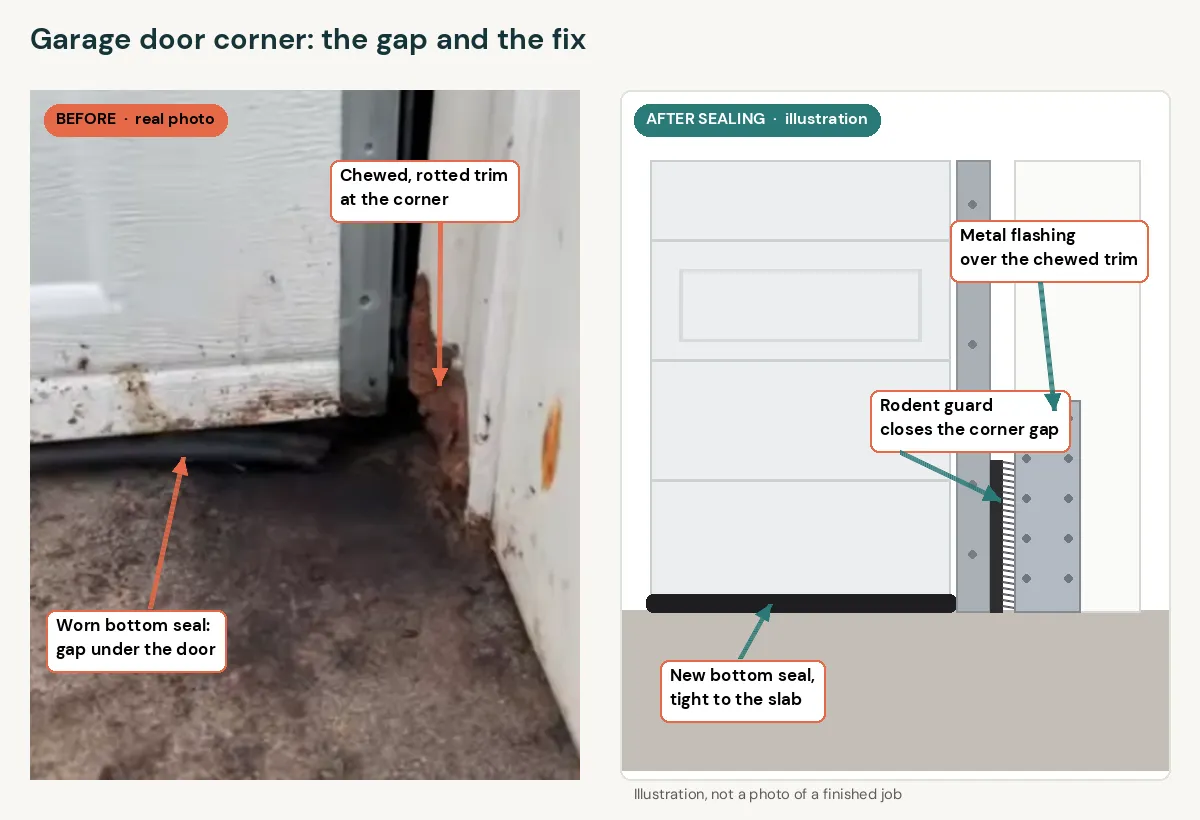
| Garage door bottom and side seals | Rubber wears flat in Texas heat | New bottom seal and side brush seals |
| Dryer vent | Flap stuck open or missing | Rodent-proof vent cover |
| Foundation and slab edge | Cracks and Norway rat burrows | Burrow fill plus an L-shaped hardware-cloth footer |
Materials we use, and what we don’t
We use
- Quarter-inch galvanized hardware cloth
- Metal flashing for roof returns and fascia
- Copper mesh, packed and sealed
- Weep-hole screens
- Door sweeps and garage seals
- Rodent-proof vent covers
We don’t rely on
- Spray foam on its own
- Steel wool, which rusts
- Duct tape or caulk over open holes
- Repellent sprays or scent packs
- Ultrasonic plug-ins
When should I seal, and when should I wait?
Seal the outside gaps once trapping shows activity is dropping, usually within the first week or two. If rodents are still active inside, we leave one main exit open with a one-way door until the house is quiet, then close it. That way nothing gets sealed in.
Homeowner checklist: rodent-proofing a Mesquite home
- Trim tree limbs back several feet from the roof; roof rats jump from branches.
- Walk the roofline and look for daylight at roof returns and fascia.
- Check that every gable and soffit vent has an intact screen.
- Look at where the AC lines enter the wall; the hole is often too big.
- Replace a garage door bottom seal that’s cracked or flattened.
- Make sure brick weep holes have screens.
- Keep woodpiles, stacked junk and dense shrubs away from the slab.
- Keep your half of the alley clear. City rules make owners and residents responsible for it.
Doing the high work yourself? Use a spotter and stay off a wet roof. If you’d rather we do it, book an inspection and we’ll photograph every gap first.
Exclusion prices in Mesquite
| Home | Typical Dallas-area range |
|---|---|
| Single-story ranch home, a few gaps | Lower end of $400 to $2,500 |
| Two-story or long roofline, many vents | Middle to upper end |
| Add-on: trapping and follow-ups | $150 to $450 |
Every quote lists each entry point and what it costs to close. See rodent control cost in Mesquite for the full picture, or how our process works.
Rodent exclusion questions
What is rodent exclusion?
Rodent exclusion means sealing every gap rats and mice use to get into your house, with materials they can’t chew through. Traps remove the rodents already inside; exclusion stops the next ones.
Should I seal entry points first or trap first?
Trap first, seal once activity drops, then keep checking. Seal too early and you trap rodents inside, where they chew new holes. Never seal and new ones keep walking in. A one-way exclusion door can let the last ones out.
Is steel wool or copper mesh better?
Copper mesh. Steel wool rusts in Texas humidity and falls apart within a few years, and it can stain brick. Either one should be packed tight and sealed in place, not just stuffed in the hole.
Does spray foam keep rodents out?
Not on its own. Rats and mice chew through foam easily. It can fill space behind a metal or mesh patch, but it should never be the only barrier.
How long does rodent proofing last?
Metal flashing, hardware cloth and copper mesh last for years when installed right. New gaps can still open as fascia ages, seals wear or limbs grow back over the roof, so a yearly look at the roofline is worth it.
How much does rodent exclusion cost in Mesquite?
Dallas-area sealing jobs usually run $400 to $2,500. Single-story ranch homes with a few gaps sit at the low end; larger homes with long rooflines and many vents cost more.
The longer you wait, the worse it gets
Every night rodents stay, they lay down more scent trails, soil more insulation and chew more wiring.
Open gaps bring the next group
Scent trails lead new rodents to the same holes within weeks.
Foam fixes fail
Rats and mice chew through foam, and the gap is back by next season.
Sealing too early backfires
Rodents sealed inside chew new holes, often through drywall.
Want the gaps found and closed?
Call or text. We’ll photograph every entry point on your house and give you a line-by-line price to seal them.